
Alexis Kariuki is a 31-year-old lesbian living in Kawangware slums, Kenya. Kariuki endured inhumane discrimination from family and friends for years before she/he eventually found solace in one organization that acknowledges the rights of LGBTQ+ people. Today, Kariuki is an outreach officer at LEHA.
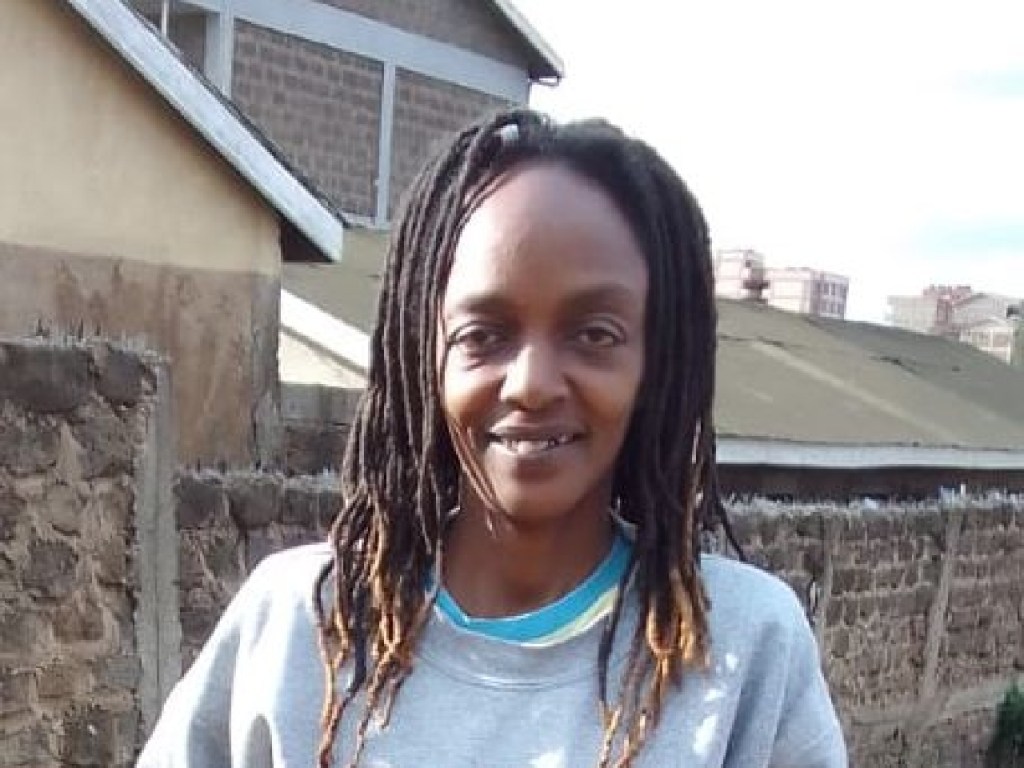
Photo: Alexis Kariuki
“As a deeply ingrained myth that is continually reinforced by social and religious authorities, homosexuality is seen as a bad omen. Being a victim of such bias, and fully convinced of my forbidden identity, I stepped out to the world feeling like a product of sin, until I found a home in one community that ignited in me new hope.”
Kawangware, KENYA- I discovered that I was different while in Secondary School. My friends had already started receiving love letters from boys, yet here I was, cold and with no feelings for boys. I felt lost.
Although I was born a woman, I was beginning to feel like a man. My body was not undergoing the typical puberty transformation. My mates wondered why my hips and breast were not changing. “Your chest is as flat as a pancake” they would burst out laughing. By then, I dismissed this as mere jest.
While in my third year in secondary school, I remember harboring some secret romantic feelings for my deskmate Esther; a thought that brushed off my mind quickly.
One day our school visited a neighboring boys’ School for a debate competition. While Esther quickly moved with the flow, I struggled to make a connection with Jack.
To be honest, I just wanted to end the awkward conversation and flee. I remember excusing myself to go for a short call. This is how my chat with Jack ended prematurely.
When we got back to our School, Esther was so excited. “I think I like Mark,” she recited with a smile. With curious blank eyes, I watched Esther diffuse in a rare romantic haze.
“Tell me about Jack?” her question caught me off-guard. “Well, it was fine, I liked him a lot ” In doubt, I lied.
When schools closed for the holidays, I traveled back to my native home. Since Esther was my neighbor in the village, I had usually spent most of my time with her.
One day, we were invited to attend a party. Here, a group of girls and boys attended the event. As expected, the mood was colored by teenage romantic coupling. Once again, I felt weird around boys. In contrast, I couldn’t stop thinking about Esther.
Later on, it was during this school holiday season that I happened to come across a very strange book that confirmed my restless doubts. It was a moving story of one South African teenage girl, and how she eventually comes to terms with the fact that she is a lesbian. It is through this book that, for the first time, I became certain of my sexual orientation.
After going back to school, Esther revisited the issue at once. “Are you a Lesbian Alexis?” She confronted me one chilly morning, “I honestly don’t have feelings for boys,” I confessed.
For a moment, Esther was lost of words. “Does anyone else know about this?” she asked assertively. “Only you, please keep it that way” I requested. I had a feeling that she would somehow be tempted to let the cat out of the bucket.
To confirm my worst fears, weeks later, I was unexpectedly called out of class one afternoon by our senior teacher. “Your friend Esther says that you are a lesbian, Is it true?”
After this, I never spoke to Esther again until we completed secondary school. It was hurting.
While at home for the school holidays, my life began getting dark. My mother broke the ice one dusty evening as we were returning home from the market. “Who has bewitched you my daughter ?”
“This is so strange, for ages, our people have dreaded this bad omen, they say that it is a sign of visitation by evil spirits,” she narrated, and sighed.
These series of attempted conversions gradually turned to stigma. I can not forget one Christmas day in the village when they celebrated in my absence. While everyone was gathered outside our family house feasting, no one seemed to bother about me. I felt useless.
This continued further to the church. I remember being forced to attend Bible study for weeks, where one of the sessions covered the story of Lot, sodomy and the ensuing destruction. “Even the Bible does not support this,” he told me as we walked out.
The mere thought of ending up in hell overpowered me. There were times when standing on the roadside, I would wish running into a speeding car.
Soon, I noticed that my father was trying to distance himself from me. My mother and other close relatives also began sidelining me.
One chilly morning in 2017, in this hopeless state, I traveled to Nairobi city secretly. A former classmate, Flora, had invited me to stay with her before I figured out my next step. In Nairobi, I joined Flora who was working as a receptionist in a city restaurant. While at her place, I secured a job in a city bar as a waitress. At first it was all smooth.
Months later, I began sensing that my workmates were sidelining me. Soon, my employer shifted me from the position of a waitress to that of a cleaner. I was shocked.
Few days later he called me on the phone saying that the bar needed to reduce its workers and that he would get back to me once things were fine. With no choice, I accepted. This is how I lost my job.
As I wallowed in grief and self-pity, I was brought back to life by her message. Flora had just met someone who was a lesbian just like me, and who was part of LEHA-an organization that supports LGBTQ+ members.
Without hesitation, Flora introduced me to Moh, a volunteer peer educator in this group. Few days later, I secured a volunteer post at LEHA.
One year later, I was assigned the role of a peer outreach educator. With this responsibility, I started to receive a monthly salary. For once, I started regaining self-confidence. I began having a sense of place and purpose. I was slowly accepting my long suppressed identity as a lesbian.
Two years down the line I was already stable enough to pay my bills. I then moved from Flora’s house in Kibera, and rented a single room in Kawangware slums. Staying alone for the first time gave me the freedom I had always hoped for.
All this while, although I missed my parents and relatives back at home, I never wished to meet any of them since I felt that they would remind me of a past I never wanted to recall.
So far, I am grateful to God for having saved me from the criticizing eyes of society. LEHA society gave me hope to live like a normal human being. Today, LEHA is my second home.
As an outreach officer at LEHA, my mandate is to equip LGBTQ+ members with knowledge and skills to ensure that they speak up when stigmatized or discriminated against.
All in all, I feel free to be myself. To all other LGBTQ+ people in Kenya, “don’t wait for freedom to come to you, it’s already in your hands, just live and let live.
Background Information
LGBTQ+ people have faced social stigma, discrimination and legal neglect for hundreds of years. Initially, this prejudice thrived under religious laws, especially those instituted by the Abrahamic beliefs, and later developed under secular legal codes-often alluding to theological traditions that preceded them.
During Colonialism, as the European powers broadened their influence over much of the world, they gradually imposed their legal policies and laws, and therefore criminalizing LGBT people in Africa, where gender diversity was perceived differently.
- Rights of LGBT People in Kenya
To date, LGBTQ+ people continue to face serious discrimination. For instance, in Sep, 2021, the Kenya Film Classification Board prohibited a gay-themed documentary titled ‘I Am Samuel‘, alleging that the film encouraged same sex relationship and marriage.
According to the International Commission of Jurists Kenya 2021, approximately between 1% and 3% of all people in the society are deemed intersex. Going by these estimations, there could be as many as 1.4 million intersex people living in Kenya.
The Constitution of Kenya which took effect on Aug, 2010, does not expressly protect the rights of LGBT persons because, according to the experts who drafted the constitution, a majority of Kenyans would have rejected the constitution in the referendum to embrace it.
- Beyond Discrimination
According to United Nations Human Rights, protecting LGBT people from violence and discrimination does not necessarily need a new set of human rights standards.
States are only required to act within the framework already established in the international human rights law, which is basically based on the Universal Declaration of Human Rights.
www.linkedin.com/in/isaac-mutia

 TimingNowKE